Program Overview
The BS in Biology provides students with a comprehensive and up-to-date foundation in the biological sciences, combining theoretical knowledge, laboratory training, and research experience. Through an interdisciplinary approach to biology, ecology, chemistry, physics, and mathematics, students gain a substantive understanding of the structure, function, and interactions of living organisms at the molecular, cellular, organismal, genetic, and ecological levels. The program promotes the development of scientific thinking, an understanding of physiological and pathological biological processes, and the evaluation of the impact of environmental factors on the function and evolution of biological systems.
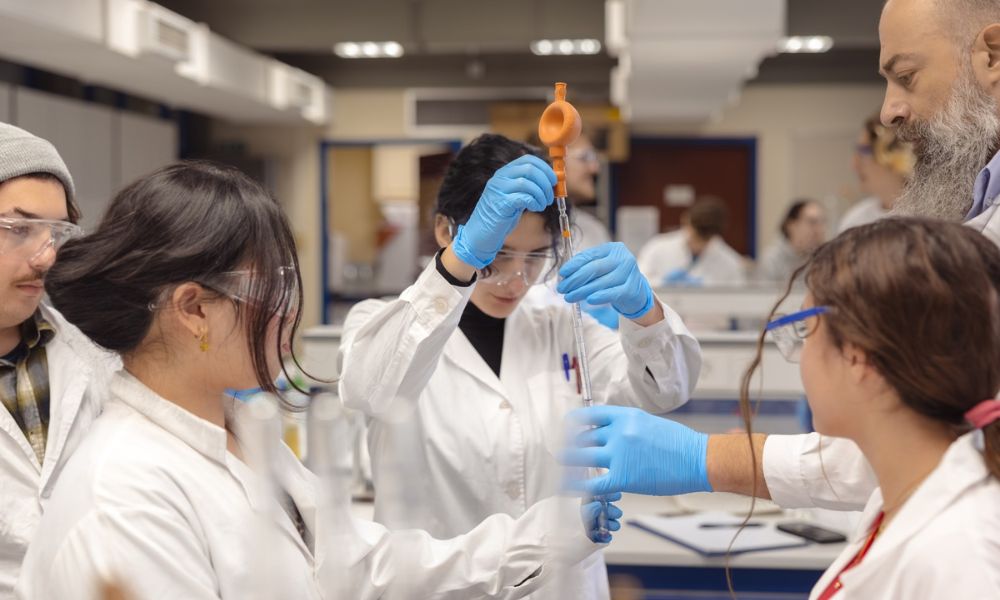
At the same time, the program cultivates students’ research, analytical, and practical skills through the application of modern laboratory techniques, data analysis, and the critical evaluation of the scientific literature. Graduates develop the ability to formulate research questions, design and conduct basic and applied research, and utilize computational and quantitative tools to solve biological problems. In a student-centered and dynamic learning environment, the program prepares graduates for successful professional careers in fields of biology or for continuing their studies in graduate programs in biology and related scientific disciplines.
Program Goals and Competencies
The program aims to:
- Provide a strong foundation in biological sciences, supported by knowledge of chemistry, physics, mathematics, and ecology.
- Develop understanding of living systems and their functions at molecular, cellular, organismal, genetic, and ecological levels.
- Develop research, analytical, computational, and laboratory skills for investigating biological questions.
- Build practical, professional, and transferable skills for employment, research, and further study.
Graduates will be able to:
- Explain fundamental biological concepts, principles, and theories.
- Use laboratory techniques, computational tools, and quantitative methods for biological research and data analysis.
- Critically evaluate scientific literature, biological data, and evidence.
- Apply biological concepts and quantitative tools to research and problem-solving.
- Formulate research questions and participate in basic and applied biological research.
Learning Outcomes and Skills
Upon completion, students will understand:
- Core concepts and principles in biology, chemistry, physics, and mathematics.
- The structure, function, development, and interactions of living systems.
- Physiological, genetic, metabolic, developmental, and pathological biological processes.
- The effects of environmental factors on gene expression, organismal development, and human health.
- Methods for collecting, analyzing, and interpreting scientific data.
- Mathematical, statistical, computational, and ICT tools used in the biological sciences.
- Specialized areas within the biological sciences.
Students will develop the ability to:
- Apply biological concepts, principles, and theories to scientific problems.
- Recognize and evaluate ethical and professional issues in biological research.
- Collect, analyze, interpret, and critically evaluate biological data.
- Design and conduct laboratory and applied biological research safely and ethically.
- Use laboratory equipment and appropriate research methods competently.
- Apply computational, quantitative, and ICT tools to biological problems.
- Plan, conduct, and present independent projects.
- Communicate scientific information effectively in written, oral, and visual forms.
- Work effectively in teams and engage in independent study and self-evaluation.
Why Study This Program
Studying Biology provides a deeper understanding of life and the processes that sustain all living organisms. It explores topics ranging from cells and genetics to ecosystems and evolution, helping students understand how organisms grow, adapt, and interact with their environments. This knowledge is essential for addressing global challenges such as disease prevention, biodiversity conservation, food security, and climate change. By studying Biology, students gain scientific literacy and a greater appreciation for the complexity and interconnectedness of life on Earth.
A Biology degree also opens the door to a wide range of rewarding career opportunities in healthcare, biotechnology, environmental management, agriculture, pharmaceuticals, and scientific research. The major develops valuable skills such as critical thinking, laboratory techniques, data analysis, and problem-solving, which are highly sought after by employers across many industries. Whether students aspire to become doctors, researchers, conservationists, educators, or biotechnology professionals, studying Biology equips them with the knowledge and practical experience needed to make meaningful contributions to science, society, and human well-being.
Who Is This Major For
The Biology major is ideal for students who are curious about how living organisms function and are passionate about understanding the natural world. It is well suited for individuals who enjoy subjects such as genetics, ecology, microbiology, anatomy, and molecular biology, and who have strong analytical and problem-solving skills. Students who like conducting experiments, interpreting scientific data, and exploring questions about life processes often find Biology to be a rewarding field of study. A solid foundation in biology also helps develop critical thinking, communication, and laboratory skills that are valuable in many scientific careers.
A Biology degree is an excellent choice for those planning to pursue careers in healthcare, biomedical research, environmental science, biotechnology, or education. It also serves as a strong foundation for graduate or professional programs in medicine, dentistry, pharmacy, veterinary medicine, and public health. Beyond traditional science careers, Biology graduates can work in areas such as conservation, science communication, forensic science, and pharmaceutical development. The versatility of the major makes it suitable for students who want diverse career opportunities while contributing to advancements in science, health, and environmental sustainability.
What Will You Study
Liberal Education Curriculum
As a required component of all undergraduate degree programs, the Liberal Education Curriculum provides students with a broad interdisciplinary foundation that complements their major while developing essential academic, professional, and lifelong learning skills.
Biology Curriculum
Students progress through a structured sequence of foundational, core, and advanced courses designed to build biological knowledge and scientific skills systematically. Foundational courses provide essential preparation in the basic sciences and related disciplines, while core courses introduce key concepts and methodologies across the biological sciences. Students can further develop their interests through elective study in areas such as Evolution and Ecology, Organismal Biology, and Molecular and Cellular Biology, before advancing to specialized, research-based coursework that emphasizes analysis, synthesis, critical evaluation, and independent scientific inquiry.
Career Opportunities
Upon successful completion of the program, students are awarded a Bachelor of Science (BS) in Biology.
Graduates of the Biology program acquire the knowledge, abilities, and skills that enable them to pursue careers in the field of biology and to qualify for a variety of positions in both the scientific and health sciences sectors. Potential employers include biomedical institutions, diagnostic centers, and hospitals; the pharmaceutical industry; the food industry, environmental organizations focused on species and ecosystem conservation, public and private education, as well as health-related positions, in accordance with the applicable national and European regulatory frameworks. At the same time, they have the opportunity to pursue graduate-level studies in related fields. Provided that students select specific courses and meet the requirements set forth in the applicable legal framework, the program may fulfill the prerequisites for practicing certain legally regulated professions.
Graduates may find employment in:
- Analytical and diagnostic services*
- Research and investigation*
- Preparation of biological reports
- Design and implementation of clinical trials*
- Cosmetics industry*
- Dentistry*
- Environmental agencies
- Health and safety
- Bioinformatics / Health informatics*
- Biology Education*
- Health Prevention and Promotion Specialist
- Laboratory Technician
- Leadership, administrative, or specialized professional positions
- Medical representatives/sales representatives
- Medicine*
- Graduate research training *
- Science communication
- Science education
- Veterinary medicine*
- NGOs
- Quality control laboratories
- Water resource management
*Note: Further study is required or may be required for some of the career options listed below.
Program Faculty

Styliani Apostolaki, PhD
FACULTY
Environmental Science
Environmental Science

Thodoris Argyriou, PhD
FACULTY
Evolutionary Biology, Environmental Science, Geology, Paleontology
Evolutionary Biology, Environmental Science, Geology, Paleontology

Dimitrios Christou, PhD
FACULTY
Applied Mathematics
Applied Mathematics

Ioannis Kougkoulos, PhD
FACULTY
Environmental Science, Risk Management, Geography
Environmental Science, Risk Management, Geography

Leonardos Mageiros, PhD
FACULTY
Computer Science, Bioinformatics
Computer Science, Bioinformatics

Georgia Tsiliki, PhD
FACULTY
Statistics, Bioinformatics, Cheminformatics and Nanotoxicology
Statistics, Bioinformatics, Cheminformatics and Nanotoxicology
Michail Valachas, PhD
FACULTY
Biochemistry, Virology, Molecular Ecology, Chemistry-Epidemiology
Biochemistry, Virology, Molecular Ecology, Chemistry-Epidemiology
This page presents the faculty involved in the courses of the Study Program during the first year of operation of Deree, The American University of Greece U.L.E.. The website will be updated to include the faculty for subsequent years, in accordance with the academic structure of the Program.
Liberal Education Faculty
The Liberal Education courses included in each program of study are taught by members of the Liberal Education faculty, who support the full range of relevant courses across all programs.
Inquiry Form